How to Safely Ship Items
Learn how to safely ship items with the right box, padding, sealing, and labeling to reduce damage and delays.
On this page
How to Safely Ship Items
Shipping looks simple until a box arrives crushed, wet, or opened at the seam, and a mug can survive 600 miles and still break on the last doorstep. The good news is that how to safely ship items is mostly a matter of order: pick the right container, protect the contents, seal well, and keep proof of what you sent.
That order matters because shipping is rough on packages. Boxes get stacked, slid, dropped, and sometimes turned upside down three times before they reach a porch. A seller sending a ceramic lamp and a parent mailing a laptop charger do not need the same package, and treating them the same is where many mistakes begin.
1. Choose the Right Packaging
Start with the item itself. A paperback book can travel in a padded mailer, but a framed print, a glass jar, or a power tool needs a box with room for padding. Heavy items need a sturdy corrugated box with intact corners, not a recycled grocery box that has already been bent and taped twice, and the best packaging for shipping items depends on the item’s size, weight, and shape.
Clean materials help. A box with oil stains, torn flaps, or crushed edges can fail before it reaches the carrier’s truck. If you reuse packaging, strip off old labels and check every seam; one half-hidden barcode can send the package to the wrong hub.
Crates are for the awkward cases. A tall sculpture, a machine part, or anything with odd weight distribution can shift too much inside a normal box, so wood or reinforced packaging may be the safer choice. A padded mailer is fine for something flat and light. It is not magic.
The size of the outer package should fit the item plus padding, and too much empty space means movement, and movement means damage. Too little space leaves no room for cushioning, and the item takes the hit instead of the package.
Simple packaging checks
- Use a box with intact corners and flaps.
- Match the package type to the item’s weight.
- Choose clean materials without old damage.
- Leave space for cushioning on every side.
A box that looks “good enough” often fails at the worst moment. A corner tear can open wider after one conveyor belt, and a soft mailer can flatten under a heavier parcel. For a sender who only ships once or twice a year, this is the moment to slow down and buy the better box.
2. Protect the Item Inside
Wrap the item before it goes into the package, and bubble wrap, paper, foam, or molded inserts all work when they fit the object and stop it from shifting. A ceramic bowl should not touch the box wall directly, and a camera lens should never sit loose in the center with a single strip of tape holding it in place. If you need a quick starting point, how to pack fragile items for shipping begins with full wrapping and solid cushioning.
Fragile items need padding on all sides, not just the bottom. If the item has handles, knobs, or sharp edges, protect those first because they are the parts most likely to break or punch through the outer box. An irregular shape often needs several smaller layers rather than one thick one, especially if the object has a hollow center or an uneven base.
A useful test is the shake test. Close the package temporarily and give it a gentle shake, and if you hear movement, the contents can move during transit too. If the item moves at all, add more cushioning before you seal the final tape line.
Do not mix loose fill with heavy or fragile items unless the box is large enough to keep the item centered. Packing peanuts can settle, and a heavy object can work its way to one side. That is how a glass bottle ends up pressing against one corner for the whole trip.
For multiple items in one box, separate each piece. Plates need dividers. Glass ornaments need their own wrap. A charger and its cable should not be left to knot themselves into a hard clump by the time the package reaches the destination.
One small aside: if the item was expensive enough to make you nervous, it probably deserves one more layer of padding than you think. Nervous is a useful signal here.
Padding that works
- Wrap the item fully.
- Pad the base and sides.
- Fill all empty space.
- Close the box and check for movement.
Odd shapes take patience. A vase with a narrow neck and wide base may need extra material near the top so it does not wobble in the box, and a bike part or lamp arm may need a custom wrap so one protruding section does not take the full impact. This is one place where the phrase “good enough” costs money later.
3. Seal and Label the Package
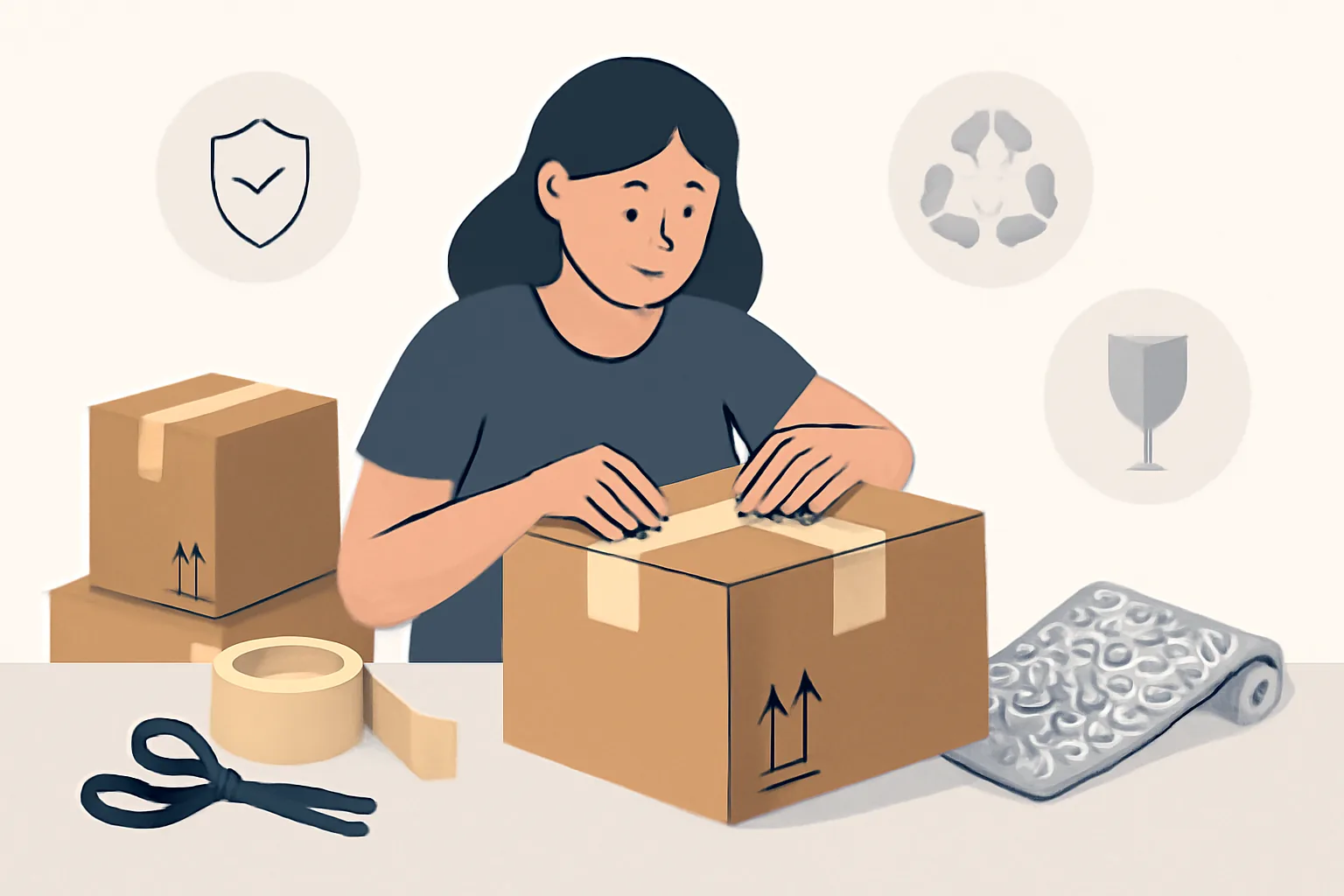
Tape the box in more than one direction. The top and bottom seams should each be closed with strong packing tape, not office tape that peels in cold air or under pressure. A common mistake is to tape only the center seam and ignore the edges. That leaves the flaps vulnerable when the package shifts in a van.
Write or print the address clearly. The recipient name, street address, apartment or unit number, city, state or region, and postal code all need to be easy to read. A label with one blurry line can cause a delay, and a delay can mean the package sits in a warehouse for days while someone tries to identify it.
Handling marks can help, but they do not replace good packing. “Fragile” or “This Side Up” may be useful for a glass item or a liquid-filled container, though they are not guarantees, and some carriers treat these notes as guidance, not promises, so the package still needs to survive on its own.
Place labels on the largest flat surface and avoid seams, corners, or tape overlaps when possible. A label wrapped around an edge can be hard to scan, and a scanner failure often means manual sorting. That adds time, and time is never friendly to a package that already has weak padding.
Remove old shipping labels completely if you are reusing a box, and one forgotten label can send the package to a previous destination or confuse the tracking system. It sounds minor. It is not.
4. Pick a Reliable Shipping Service
Different shipping services trade speed for cost and handling. Express options are usually faster, while ground services may be cheaper for nonurgent items. The best choice depends on the item’s value, the distance it must travel, and how quickly the recipient needs it, and if the package contains a birthday gift with a fixed date, speed matters more than saving a small amount on postage.
Tracking is worth paying for on items that would cause trouble if they disappeared. A box of replacement parts for a business order or a family heirloom should not travel blind if a tracked option is available. For low-value items, tracking may still be useful just to confirm delivery and stop the “Did it arrive?” messages.
Carrier handling also matters. Some services move packages through fewer handoffs, while others sort aggressively through larger hubs. Fewer handoffs can mean less chance of damage, although the exact path varies by carrier and service level. A heavier box with fragile contents usually benefits from a service with better handling records, not just the cheapest label.
If you need help deciding among services, the overview at The 7 Admister services can help you compare what matters before you buy a label. It is not about finding the fanciest option. It is about matching the package to the journey.
For a time-sensitive shipment, ask one practical question: what happens if it arrives two days late? If the answer is “nothing serious,” ground shipping may be enough, and if the answer is “the recipient misses the event,” choose the faster service and keep the tracking number close.
5. Confirm Shipping Restrictions
Before you send anything, check whether the item is restricted or prohibited. Batteries, liquids, aerosols, sharp tools, perfumes, and some electronics may face rules that differ by carrier and destination. A package that is fine within one country may be rejected at a border or held for inspection.
Destination rules matter as much as carrier rules, and one country may allow a product in small quantities but ban it in commercial volume. Another may require paperwork for medicine, plants, food, or anything that can be seen as controlled material. A sender who skips this step can end up with a returned package, extra fees, or a destroyed item.
Check size and weight limits too. A box that seems normal at home may exceed the carrier’s maximum once it is measured on site, and carriers also set rules for packaging quality, battery isolation, and labeling. Some of these rules are buried in policy pages, which is why a careful read before drop-off saves time later.
People often assume that if a store can mail an item, anyone can mail the same item. That is not always true. Retailers have accounts, special packing methods, and carrier agreements that a casual sender does not have.
If you are unsure, ask the carrier directly or check the destination’s import rules. A simple question now can prevent a long delay later. This is the quiet part of how to safely ship items: knowing what not to send is as useful as packing the right way.
6. Add Tracking and Insurance
Tracking should be standard for anything you would want to prove was sent. A signed contract, a vintage watch, or a replacement phone battery all benefit from tracking because it records movement and delivery status, and save the tracking number in at least two places: your order record and your email. Losing the number after drop-off is a small mistake with a large cost.
Delivery confirmation matters when the recipient is not home every day or when the address includes a shared building. A scan showing “delivered” is not the same as hand-to-hand delivery, but it does give a clear event to compare against any later complaint. If the package needs a signature, keep that record too.
Insurance is for value, not optimism. If the item would hurt to replace, consider insuring it for the amount you can document, and receipts, photos, serial numbers, and a description of the contents may all be needed if you file a claim. Without those records, a claim can stall or be reduced.
Take photos before sealing the package. One photo of the item, one of the padding, and one of the sealed box can help show condition and packing quality. That matters after a claim, but it also helps if you need to remind yourself what was inside. Memory gets fuzzy. Paper does not.
Some carriers have limits on claim windows, so do not wait if the package arrives damaged or fails to arrive. Check the policy before shipping, then save the receipt, label copy, and tracking details until the shipment is fully closed out, and a missing receipt can make a simple claim much harder.
7. Prepare for Delivery and Follow-Up
After drop-off, monitor the tracking at least once per day for an item that matters. If the scan stops in one city for too long, contact the carrier while the package is still traceable. Waiting a week can turn a small delay into a missing package case.
Notify the recipient with the tracking number, the expected service, and any handling notes that are relevant, and a person expecting a package can watch for it, avoid leaving it outside, and check the box right away. That first hour after delivery is the best time to catch damage. After rain, after dark, after a porch transfer, details can be lost quickly.
If the package arrives damaged, ask for photos before the box is discarded, and damage to the outer carton, the inner cushioning, and the item itself can all support a claim. A torn seam on one side may reveal how the package was handled, while a crushed corner can show impact. Keep the original packaging until you know whether a claim is needed.
Document the shipment even if nothing goes wrong. A basic record with the date, address, contents, tracking number, and service level makes repeat shipping easier the next time, and it also helps if you ever need to prove what was sent and when. For users who need support after a problem, Getting support is the place to start.
If you ship often, make a habit of checking the package before it leaves your hands and again after delivery is confirmed. That routine takes less than 5 minutes once you know it well. The payoff is fewer surprises, and fewer surprises is the whole point.