How to Avoid Counterfeit Goods on Classifieds
Learn how to avoid counterfeit goods on classifieds with practical checks for listings, sellers, photos, and used item authenticity checks.
On this page
- How to Avoid Counterfeit Goods on Classifieds
- 1. Understand the Risks Before You Browse
- 2. Search Listings with a “Too Good to Be True” Filter
- 3. Check the Seller’s Profile and Listing History
- 4. Use Used Item Authenticity Checks Before You Commit
- 5. Ask the Right Questions and Request Proof
- 6. Compare the Item Against Official References
- 7. Meet Safely, Inspect In Person, and Pay Securely
- 8. What to Do If You Suspect a Counterfeit
How to Avoid Counterfeit Goods on Classifieds
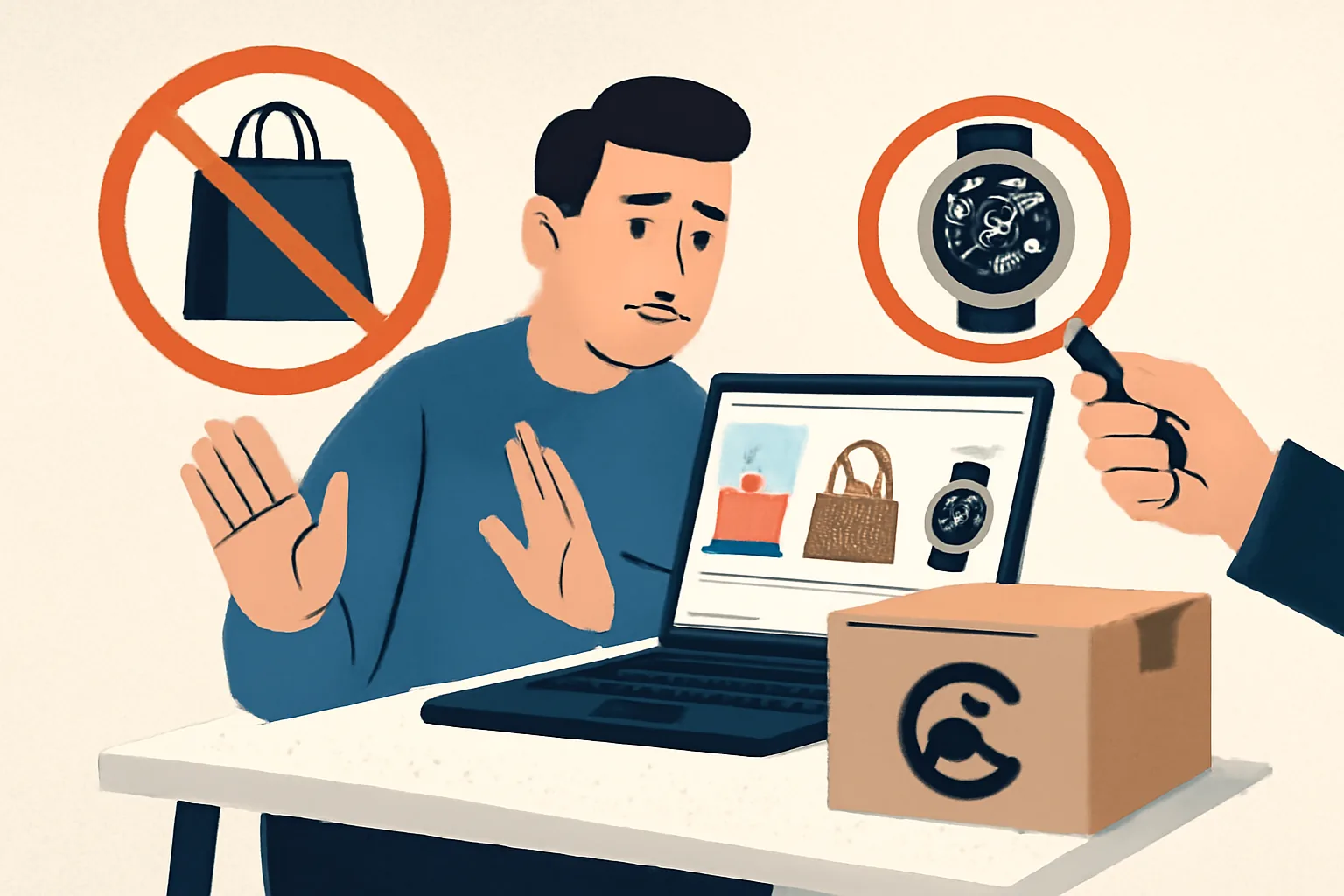
Classifieds can be a practical way to buy what you need without paying full retail, but they also attract sellers who know exactly how to dress up a fake, and counterfeit goods are not limited to luxury handbags and watches. They show up in headphones, sneakers, cosmetics, phone accessories, tools, and even children’s products. The danger is not just losing money. Some fakes wear out quickly, fail to work properly, or create safety risks you only discover after the sale.
The good news is that most counterfeits leave clues. If you slow down, ask a few pointed questions, and compare what you see against reliable references, you can avoid a lot of trouble. That means building the right habit from the start: assume every listing needs to earn your trust, and learn how to spot fake branded items before you commit. If you need a quick refresher on platform basics before you start browsing, How Admister works is a useful place to begin.
1. Understand the Risks Before You Browse
It helps to be honest about why counterfeit goods thrive on classifieds. Sellers can post quickly, change accounts easily, and present items in a way that looks ordinary at first glance. A fake product does not always come with obvious red flags. Sometimes it is a careful imitation with a borrowed brand name, a convincing photo, and just enough detail to sound legitimate.
That is why the safest mindset is caution, not excitement. If you start by assuming the deal may be flawed, you are less likely to be pulled in by a bargain that looks urgent or exclusive, and a clean listing and a friendly seller are not proof of authenticity. They are only the beginning of your review.
Watch for the kind of signals counterfeit sellers often rely on: generic descriptions, stock-style images, a sudden rush to close the sale, or a price that sits far below what similar items usually command. None of these proves a fake on its own, but together they should make you pause. If the seller seems more interested in quick payment than in answering questions, that is worth noting too.
2. Search Listings with a “Too Good to Be True” Filter
One of the most useful habits on classifieds is to treat unusually low prices as a research prompt, not an opportunity. Branded products have a market range, and while used items can certainly be discounted, there is a difference between a fair second-hand price and a number that makes no sense at all, and a listing that undercuts every similar offer may be legitimate, but it deserves closer scrutiny.
Read the description carefully. Counterfeit listings often stay vague where real sellers usually get specific. A genuine owner tends to mention condition honestly, include signs of wear, and explain why they are selling. A seller offering a fake may lean on broad claims like “original,” “premium quality,” or “perfect condition” without naming the model, version, or purchase history. The lack of detail is the detail.
Photos matter just as much. Stock images, overly polished pictures, or photos that seem copied from a product page are all caution flags, and you want to see the actual item, in the seller’s environment, from several angles. If every picture looks like an advertisement, ask yourself why the seller avoided simple real-life shots of the item on a table, next to packaging, or under normal light.
Pay attention to the seller’s behavior too. A counterfeit seller may create pressure by saying other buyers are waiting, the price is “for today only,” or the item will be gone in an hour. That urgency is often there to stop you from verifying the details. Good deals do not usually require panic.
3. Check the Seller’s Profile and Listing History
A listing tells only part of the story. The seller’s profile can reveal whether you are dealing with a regular user, a reseller, or an account that appeared out of nowhere, and look at how long the account has been active, what else it has listed, and whether the items make sense together. A person who has casually sold household goods over time is easier to understand than an account posting multiple high-end brand items in a narrow category with little history behind it.
Consistency matters. Does the seller describe items in the same style from one listing to the next? Do the photos appear to be taken in the same place? Are there signs of familiarity with the product category, or does the account feel assembled for a single purpose? If the seller is vague about where an expensive item came from, ask for a simple backstory. For example, “Was this bought new by you, received as a gift, or acquired second-hand?” A trustworthy seller usually answers directly.
If the explanation shifts every time you ask, treat that as a warning. Authentic owners usually know the basics: where they got it, how long they used it, and why they are selling. A tangled story can be a sign that the seller is improvising.
It can also help to use the phone number as part of your broader trust check, especially when a seller wants to move off-platform quickly. Our guide on how to check a seller’s phone explains how to approach that step carefully without overreaching.
4. Use Used Item Authenticity Checks Before You Commit
Used item authenticity checks work best when you are systematic. Do not rely on one feature alone. Counterfeiters can copy a logo, but they often struggle to reproduce the whole product faithfully. Build your inspection around a few basic elements:
- Labels and tags: Check spelling, font weight, alignment, and placement, and small errors are common in fakes, especially on care labels, size tags, and interior markings.
- Stitching: Real branded goods tend to have consistent stitching patterns. Uneven lines, loose threads, or asymmetry can point to poor manufacturing.
- Serial numbers and codes: If the item uses a serial number, inspect whether it looks engraved, printed, or applied in a way that matches the brand’s standard, and a code alone is not enough; it must fit the product.
- Hardware: Zippers, clasps, screws, and buckles should feel solid and fit cleanly. Cheap-feeling hardware on a premium item is a classic warning sign.
- Packaging: Boxes, dust bags, instruction cards, and warranty papers can help, but they are also easy to fake, and compare them carefully rather than trusting them at face value.
Product-specific markers matter too. For sneakers, compare the sole pattern, tongue label, and logo placement. For electronics, examine ports, button spacing, menu behavior, and model identifiers. For cosmetics, study batch codes, seal quality, and typography, and for watches, look at case finishing, weight, movement details, and the way the crown or clasp operates.
The aim is not to become an expert overnight. It is to notice whether the item feels coherent. Authentic products are usually consistent in dozens of small ways. Fakes often get the headline details right and the quiet details wrong.
5. Ask the Right Questions and Request Proof
Good questions do more than gather information, and they also reveal how the seller responds under light pressure. Ask for the original receipt if one exists, but do not assume a receipt is conclusive. Receipts can be lost, copied, or unrelated to the item being sold. Still, a real purchase record is one useful piece of context, especially if it matches the model and timing.
Ask whether the seller still has original packaging, inserts, warranty cards, or service paperwork. For some categories, service history can be especially useful because it may show serial numbers or repair records that align with the product. If the seller says everything was discarded, that is not automatically suspicious, but it does reduce the evidence available to you.
Request additional photos in natural light. Ask for a close-up of key points: labels, stitching, serial plates, hinges, seams, connectors, or any other feature that defines the product, and if possible, ask for a handwritten note in the photo with the current date or your username. That simple step helps confirm that the seller actually has the item in hand and did not pull images from somewhere else.
Be careful with sellers who answer only the easy questions. A genuine seller should not object to showing the parts of the item that matter most. If they dodge, rush, or become irritated when asked for proof, that tells you something. Not everything, but something.
6. Compare the Item Against Official References
One of the best defenses against counterfeit goods is comparison, and put the listing side by side with official brand images, model pages, and authorized retailer photos. Look for differences in proportions, logo placement, texture, finish, and included accessories. A fake may look close in a casual thumbnail, then fall apart under a slower look.
Pay attention to model details. A listing may claim to offer a specific edition or year, but the photographs show features from a different version. That could be a simple mistake, or it could be a sign that the seller copied a description without understanding the product. Either way, the mismatch matters.
Also compare the seller’s item with known authentic examples from reliable sources, and community forums can be helpful for spotting common counterfeit traits, but official brand references should come first. If a product line has several visual revisions, confirm which version you are supposed to be seeing. The more precise the model, the easier it is to notice a mismatch.
Do not ignore packaging inconsistencies either, and a genuine item with the wrong box, incorrect instruction leaflet, or mismatched accessory set deserves skepticism. Sometimes a counterfeit product is paired with authentic packaging to make it look safer. Other times the packaging itself is the fake giveaway. Both should be checked.
7. Meet Safely, Inspect In Person, and Pay Securely
If the item is local, an in-person meeting is often the best chance to verify authenticity before money changes hands, and choose a public place with enough light to inspect the item properly. A rushed handoff in a car park or at a door does not give you the space to look carefully, and that is exactly when mistakes happen.
When you meet, inspect the item before paying. Check the features you identified earlier and compare them against the photos and references you saved. If anything feels off, stop. You do not owe anyone a purchase because you showed up. A seller who refuses a brief inspection is effectively asking you to buy blind, which is a poor arrangement for anything branded or high-value.
Be wary of pressure tactics: “There are other buyers coming,” “You need to pay now,” or “I already drove here.” None of that changes the product in your hands, and a legitimate seller should understand that a real buyer wants to verify what they are getting.
Pay securely and keep the transaction traceable where possible. Avoid side arrangements that remove buyer protection or make it harder to resolve a dispute later. If the seller insists on an opaque payment method and will not allow inspection first, think twice, and a slightly better price is not worth a dead-end transaction.
8. What to Do If You Suspect a Counterfeit
If something feels wrong, do not force the deal. The simplest and safest response is to walk away. You do not need to prove the item is fake in the moment, and you do not need to debate it with the seller. A calm refusal is enough.
Preserve everything. Save the listing, screenshots, messages, photos, payment details, and any notes from the meeting. If the platform allows reporting, submit the listing with a short factual explanation of why you suspect a counterfeit item. Stick to what you observed: mismatched markings, suspicious pricing, refusal to provide proof, or inconsistent story details.
If you have already paid and received a fake, escalate promptly through the platform and any applicable consumer or law enforcement channels where appropriate, and the correct path depends on your location and the value of the item, so follow local rules carefully. If you need support navigating platform steps, Getting support can help you find the right contact route.
One final point: do not dispose of the item immediately if you plan to report it. Keep the packaging and all evidence together. That makes it easier to document what happened and strengthens your case if you need to challenge the transaction later.
Buying on classifieds does not have to feel risky every time. With a careful eye, a few sensible checks, and a willingness to pass on doubtful offers, you can avoid many counterfeit traps before they cost you money, and the trick is not to chase certainty where none exists. It is to gather enough evidence to make a sensible decision — and to leave when the evidence is thin.